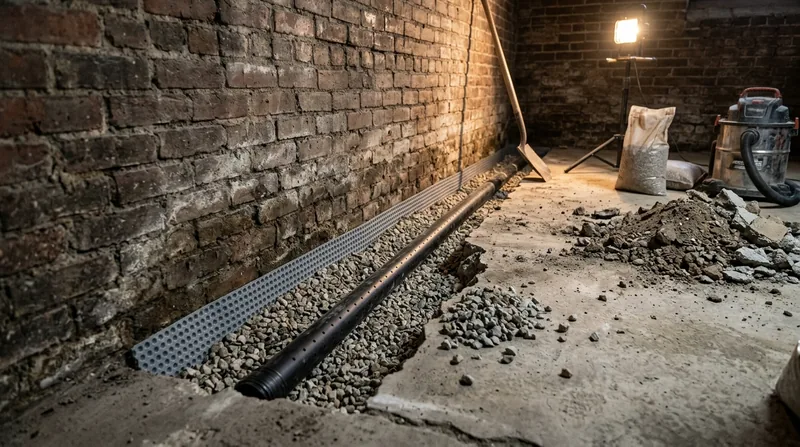




If you live on Museum Hill, in Patee Town, or along the bluff streets above the Missouri River, you already know what spring rain does to a brick foundation. The loess soil that makes St. Joseph beautiful also holds water like a sponge and softens when saturated, pushing hydrostatic pressure against basement walls that were laid by hand in the 1880s. That pressure finds every mortar joint, every hairline crack, and every cold pour seam. An Interior Drain Tile System in St. Joseph intercepts that water at the footing before it ever reaches your floor, channels it to a sump basin, and pumps it out and away from the house. We install these systems year round, in any season, and we specialize in the older brick and limestone foundations that define this city. If you are tired of a wet basement after every storm, start with a free basement inspection and we will tell you plainly what is happening below grade.
Why Interior Drain Tile Matters on St. Joseph's Loess Bluffs and River-Bottom Clay
St. Joseph sits on wind-deposited silt bluffs above a bend of the Missouri River, and the soil profile changes block by block. On the bluff streets, runoff from steep grades pours downhill and soaks in fast. Along the river bottom, glacial clay and river-bottom soils hold water and drain slowly. Both situations create the same result in a full basement: a rising water table and steady hydrostatic pressure against the footing. That is the failure mode that dominates here, not a single cracked wall but water coming in along the entire floor-to-wall joint.
- Water seeps through the cove joint where the floor slab meets the brick or block wall, especially after heavy spring rain.
- Efflorescence (the white salt powder) shows up on 1920s bungalow walls on the North End when moisture moves through the masonry.
- Old brick and limestone foundations on Robidoux Hill wick water and soften mortar over decades of freeze-thaw cycles.
- Downspouts that dump at the corner of a foursquare on Cathedral Hill send roof water straight down along the footing.
- Homes on the east edge with poured-concrete basements still take water at the cold joint when the water table rises.
When you see any of these signs, the fix is not another coat of sealer on the inside face of the wall. The water has to be captured at the footing and moved away.
Key info: A homeowner in Patee Town called us after every heavy rain left an inch of water on the basement floor. The walls were dry above the cove joint, which told us the problem was hydrostatic pressure at the footing, not a failing wall. An interior perimeter drain and sump basin solved it without excavating the yard.
For official guidance on permits and contractor requirements in Missouri, the city's building department is the authority to check before any below-grade work begins. You can review local permit information through the City of St. Joseph offices.
How We Install an Interior Drain Tile System in St. Joseph Homes
We do not guess at the water source. The job starts with a walkthrough of the basement, the exterior grade, and the downspout layout so we know where the water is entering and how much volume the system has to handle. Then we set up containment, because we are cutting concrete in your home and dust control matters. The work happens in a predictable sequence, and we keep you informed at each stage.
- We mark the perimeter and cut a channel in the slab about 12 inches from the wall, staying clear of the footing.
- We dig a trench down to the footing level and remove the spoil from the basement.
- We lay perforated drain tile in washed gravel with a filter fabric wrap to keep silt out of the pipe.
- We set the sump basin at the low point, connect the drain tile, and install the pump with a check valve on the discharge line.
- We route the discharge line to a daylight outlet or a dry well, keeping it away from the foundation and off the neighbor's property.
- We backfill with gravel, pour new concrete over the channel, and leave the floor clean and level.
Every system we install is sized for the home, not pulled off a shelf, and we test the pump and the float before we call the job done.
Key info: On a 1920s foursquare in Midtown, the old footing drain had collapsed and the basement flooded every March. We tied the new interior perimeter drain into a new sump basin and added a battery backup sump pump so the system kept running through the spring power outages that roll through Buchanan County.
Interior Drain Tile Approaches We Use in St. Joseph
Not every basement needs the same system. The right approach depends on the foundation type, the water volume, and whether the floor slab can be opened. Here is how we match the method to the house.
| Approach | Description | Best for |
|---|---|---|
| Full perimeter interior drain | Drain tile runs the entire inside perimeter of the footing, feeding a single sump basin. | Whole-basement seepage along the cove joint, common in older brick foundations. |
| Partial perimeter drain | Drain tile covers the wet wall or walls only, tied to a sump basin. | One-sided seepage on a hillside home where runoff concentrates on one elevation. |
| Drain tile plus vapor barrier | Interior drain paired with a wall membrane that directs wall seepage down to the tile. | Efflorescence and damp masonry walls that need moisture control above the footing. |
| Drain tile plus sump pump upgrade | New drain tile tied to a correctly sized pump with check valve and discharge line. | Homes with an undersized or failing sump pump and a high water table. |
| Drain tile repair and replacement | Existing interior drain tile is cleaned, re-graded, or replaced where it has collapsed. | Older systems that no longer carry water to the basin. |
We will tell you which approach fits your basement after we see it, and we will explain why the others do not.
Interior Drain Tile System Cost in St. Joseph: What to Expect
Pricing for an interior drain tile system starts at From $50 per linear foot, and that figure covers the channel cutting, gravel, perforated tile, and concrete restoration along the run. The total depends on how many linear feet of perimeter you have, whether the sump basin and pump are included, and how much concrete has to be opened. A small partial run on a ranch in the East Hills sits at the low end. A full perimeter on a large Victorian basement with thick limestone footings sits at the high end.
Access matters too. Basements with a narrow or steep exterior stair, or with finished ceilings and stored belongings, take more labor to protect and clear. If the discharge line has to run a long distance to a daylight outlet, that adds to the job. We do not price from a phone description, because two basements of the same square footage can need very different systems. Get two or three estimates and compare the scope line by line, not just the bottom number. You can review the full range on our pricing page before you call.
Interior Drain Tile System Near Me: How to Choose a Contractor Near St. Joseph
Waterproofing is a below-grade trade, and the contractor you hire should be able to explain the difference between hydrostatic pressure and a simple crack before they quote a number. Ask for proof of licensing and insurance, and ask for the certificate to be sent to you, not just shown on a phone. Get at least three written estimates that list the linear footage, the pipe type, the sump basin and pump model, and the discharge route. Then call two recent references with basements similar to yours.
Permits are commonly required for work that alters drainage or the sanitary connection of a sump discharge, and the thresholds vary by jurisdiction, so confirm the rules with the local building department before work starts. If your home is in a historic district or subject to association rules, check those too. A contractor who is comfortable with that paperwork is a contractor who has done this work in St. Joseph before. When you are ready, reach out through our contact page and we will schedule the inspection.
Interior Drain Tile System in St. Joseph: Pricing Guide
| Service | Price | Details |
|---|---|---|
| Partial perimeter interior drain | Starting at $50/linear ft | Covers channel cutting, gravel, perforated tile, and concrete restoration on the wet wall only. |
| Full perimeter interior drain | Starting at $62/linear ft | Includes the complete footing run, sump basin, pump, check valve, and discharge line routing. |
| Drain tile plus vapor barrier | Starting at $72/linear ft | Adds wall membrane and dimple board to direct masonry seepage down to the tile. |
| Drain tile repair and replacement | On estimate | Existing tile is camera-checked and re-graded or replaced where it has collapsed. |
| Travel | Included | In St. Joseph and surrounding Buchanan County areas, no separate call-out or mileage fee. |
| Estimate | Free | Response within 24h at (816) 339-4515, no obligation to book. |
Indicative pricing, the exact cost depends on square footage, finish, and site access. Free personalized estimate within 24h at (816) 339-4515.


