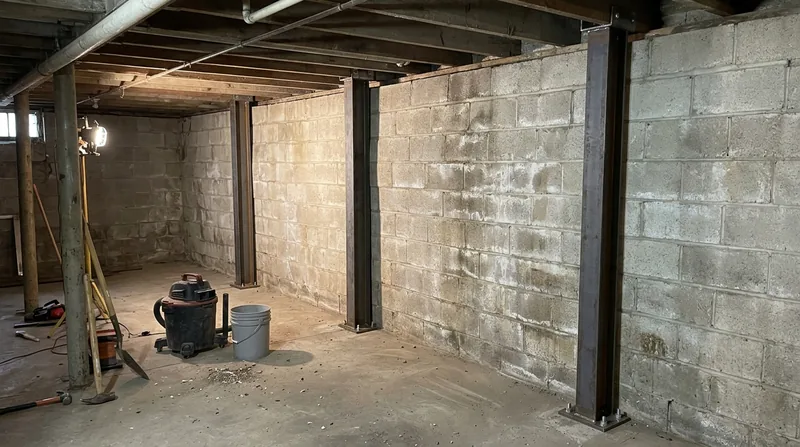




Why Bowing Walls Happen on St. Joseph's Loess Bluffs
St. Joseph sits on wind-deposited loess bluffs above the Missouri River bend, and that silt behaves badly when it gets saturated. It holds water, it softens, and it pushes hard against older block and brick basement walls on sloped lots from Hall Street to Robidoux Hill. When that lateral load exceeds what the wall was built to take, the wall bows inward. That is where Bowing Wall Repair in St. Joseph comes in: we assess the movement, match the method to the soil and severity, and stabilize the wall before it fails.
Older homes in Patee Town and on Cathedral Hill often sit on brick and limestone foundations with full basements, and 1920s to 1950s bungalows on the North End and South Side show the same pattern. If you are seeing horizontal cracks, a wall that leans into the room, or doors that stick above a bowing section, start with a free basement inspection so we can measure the movement rather than guess at it.
Why Bowing Wall Repair Matters on St. Joseph's Sloped Lots
Most bowing we see in St. Joseph traces back to hydrostatic pressure from saturated loess and river-bottom clay, not to a single bad crack. The steep bluff streets send runoff downhill fast, and winter freeze-thaw cycles work on walls that are already under load. Ignoring a bowing wall lets the movement accelerate, and once a block wall racks far enough, cosmetic fixes stop being an option.
- We measure the inward deflection with a plumb line and record it, so we can tell you whether the wall is still moving or has stabilized.
- We identify the pressure source, whether it is failing grading, a clogged footing drain, or saturated loess that never drains.
- We distinguish a bowing wall from a settling wall, because the two take different repair methods.
- We tell you plainly when simple crack sealing is enough and when the wall needs structural stabilization.
That diagnosis step is what keeps you from paying for a repair that does not address the actual load on the wall.
Key info: On Museum Hill and along Robidoux Hill, we regularly find 1890s brick foundations where the wall has bowed two to three inches over decades of saturated loess pressure. Measuring the rate of movement matters more than the total deflection.
For official guidance on structural permits in the city, check the City of St. Joseph building department before any structural foundation work begins.
How We Stabilize a Bowing Wall in St. Joseph
We start below grade and work from the soil up. The method depends on how far the wall has moved, what the wall is made of, and what the loess and clay are doing on your lot. Carbon fiber straps suit block walls with moderate movement, steel I-beams handle heavier loads, and wall anchors pull a wall back where the soil allows it. We pair the structural repair with drainage correction so the pressure that caused the bow does not keep working on the wall.
- We inspect the full basement perimeter and map every crack, bow, and sign of efflorescence.
- We measure deflection and check the footing drain and grading to find the water source.
- We recommend the stabilization method that fits the wall type and the severity of movement.
- We install carbon fiber straps, steel I-beams, or wall anchors and torque or bond them to spec.
- We correct the drainage with an interior drain tile system or exterior work so hydrostatic pressure stops rebuilding.
The structural repair holds the wall; the drainage correction is what keeps it from bowing again.
Key info: A 1940s block basement on the South Side had bowed nearly two inches after years of runoff from a steep driveway. We installed carbon fiber straps and tied the repair to a new interior perimeter drain, and the wall has held steady through the last two spring thaws.
Repair Methods We Match to Your Wall
No single method fits every bowing wall. We pick based on wall material, deflection, and soil load, and we explain the tradeoffs before we start.
| Approach | Description | Best for |
|---|---|---|
| Carbon fiber straps | Straps bonded to the wall and anchored top and bottom to resist inward movement. | Block walls with moderate bowing and stable footings. |
| Steel I-beams | Vertical steel beams set against the wall and tied into the floor and joists. | Heavier movement and walls carrying significant lateral load. |
| Wall anchors | Anchors driven into stable soil outside and tensioned to pull the wall back. | Walls that can be straightened where soil conditions allow. |
| Drainage correction | Interior drain tile, grading, and downspout extensions to relieve hydrostatic pressure. | Every bowing wall repair, to stop the cause from returning. |
Bowing Wall Repair Cost in St. Joseph: What to Expect
Bowing wall repair is structural work, and pricing reflects that. A basic stabilization with carbon fiber straps on a moderately bowed block wall starts around $600, and the number climbs with the length of wall involved, the method chosen, and how much drainage correction is needed. We do not quote structural work blind, because a wall that has moved three inches takes a different scope than one that has moved half an inch.
Factors that move the price include the wall material, the total deflection, the number of straps or beams required, access to the basement, and whether an interior drain tile system or exterior work is part of the fix. Getting two or three estimates on structural work is smart, and any contractor who quotes a bowing wall without measuring the deflection is guessing. See our pricing overview for the full picture before you compare bids.
Choosing a Bowing Wall Repair Contractor Near St. Joseph
Structural repair is not the place to hire the low bid from a truck with no lettering. Ask for proof of licensing and insurance, get multiple written estimates, and call references from jobs in the older brick and block neighborhoods where the work is hardest. Structural foundation repair commonly requires a permit, and rules vary by jurisdiction, so confirm the scope with the city building department before work starts.
Ask each contractor how they measure deflection and what they do about the water source, because a strap without drainage correction is a half repair. If a quote does not mention the footing drain, grading, or downspout extensions, ask why. Reach out through our contact page to schedule a look at your wall.
Bowing Wall Repair Near Me: What St. Joseph Homeowners Should Know
If you are searching for bowing wall repair near me in St. Joseph, the first question is whether the wall is still moving. A wall that has bowed and stopped is a different job than one that is actively racking, and the repair method and schedule follow from that answer. We serve the older neighborhoods on the bluffs and the poured-concrete basements on the east edge with the same measured approach.
Snowmelt and hard freeze-thaw cycles in late winter and early spring are when most bowing walls in St. Joseph get worse, and heavy spring rain on saturated loess adds hydrostatic pressure at the same time. Summer thunderstorms send runoff down the bluff streets, which is why we see a second wave of calls in June and July. If your wall is bowing and you see efflorescence or a musty smell in the basement, call (816) 339-4515 and we will get eyes on it before the next wet cycle.
Bowing Wall Repair in St. Joseph: Pricing Guide
| Service | Price | Details |
|---|---|---|
| Carbon fiber strap stabilization | Starting at $600 | Covers assessment and strap installation on a moderately bowed block wall, with price rising by strap count and wall length. |
| Steel I-beam reinforcement | Starting at $1,200 | Includes beam placement tied into floor and joists, with cost moving on wall height, beam count, and access. |
| Wall anchor system | On estimate | Requires an outside excavation look at soil conditions before we can quote anchor count and tensioning scope. |
| Drainage correction add-on | On estimate | Interior drain tile or exterior work priced after we trace the water source feeding the wall. |
| Travel | Included | In St. Joseph and surrounding areas, with no separate call-out or mileage fee. |
| Estimate | Free | Response within 24 hours at (816) 339-4515, with no obligation to book. |
Indicative pricing, the exact cost depends on square footage, finish, and site access. Free personalized estimate within 24h at (816) 339-4515.


