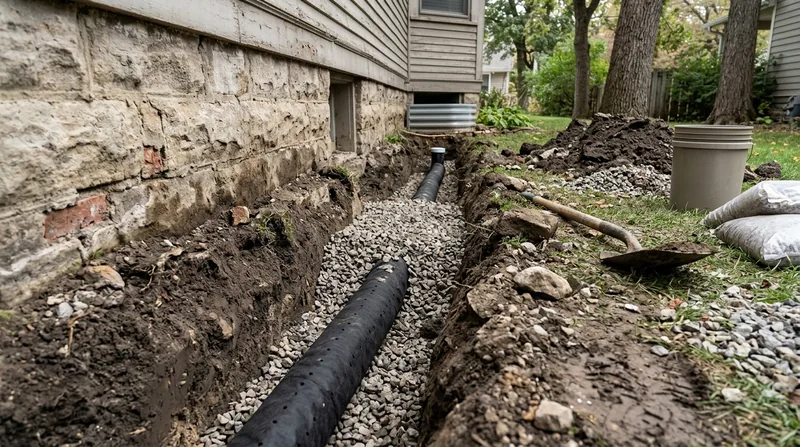




St. Joseph sits on a thick blanket of wind-deposited loess above the Missouri River bend, and that silt behaves like a sponge in spring. Water soaks in fast, then creeps downhill along the bluff streets toward foundations that were laid on brick and limestone in the 1880s. If your basement takes on water after a heavy rain, the problem is usually groundwater arriving from uphill, not a crack in the wall. French Drain Installation in St. Joseph intercepts that water before it ever reaches the footing. We install graded gravel and perforated pipe systems along the foundation, wrapped in filter fabric and tied to daylight or a sump basin. It is the right first move for homes on the bluffs where runoff arrives from above. For a broader look at how drainage fits into a full water-management plan, see our basement waterproofing service.
Why French Drains Matter on St. Joseph's Loess Bluffs
The dominant failure mode here is hydrostatic pressure from saturated loess and river-bottom clay. During a wet spring, the soil above your foundation holds water until it pushes against the wall. That pressure finds every mortar joint in a 1900s brick foundation on Museum Hill or Robidoux Hill. A french drain relieves that pressure by giving the water somewhere to go. It is not a cosmetic fix. It is the difference between a dry basement and a wet one.
- Loess softens when saturated, so water moves downhill toward foundations on streets like Hall Street and the Cathedral Hill blocks.
- Older brick and limestone foundations in Patee Town wick moisture through mortar joints when the soil stays wet.
- Steep bluff grades send runoff from uphill lots onto lower foundations during summer thunderstorms.
- River-bottom clay along the Missouri holds water after the 2011 and 2019 flood cycles, keeping the water table high.
- Freeze-thaw cycles crack parging and open seams that let groundwater in during the spring melt.
Every one of these conditions points to the same answer: move the water away from the wall before it becomes a wet basement.
Key info: A homeowner on the East Hills called us after every spring rain left two inches of water on the basement floor. The culprit was runoff from a neighbor's uphill driveway, not a wall crack. A french drain along the uphill side of the foundation ended the problem.
The City of St. Joseph Building Department handles permits for work that alters drainage or ties into the sanitary connection. Rules vary, so verify before you dig. You can start at the City of St. Joseph official site.
How We Install a French Drain on a St. Joseph Foundation
We start by walking the grade and reading the water. On bluff lots, that means finding where runoff enters the property and where it can safely leave. We check the footing depth, the soil type, and whether the existing drain tile still functions. Then we lay out a system that intercepts water before it reaches the wall. No guesswork, no cookie-cutter trench.
- We mark the trench line along the foundation and confirm the fall to daylight or the sump basin.
- We excavate to the footing, keeping the trench wide enough for gravel and fabric.
- We line the trench with filter fabric to keep loess silt out of the pipe.
- We set perforated pipe on a graded gravel bed, holes down, with a consistent slope.
- We wrap the gravel in fabric and backfill with clean stone, then restore the grade.
- We tie the outlet to daylight or a sump basin with a check valve on the discharge line.
On a 1920s foursquare in Midtown, the trench ran 60 feet along the uphill wall and tied into a new sump basin. The basement stayed dry through the next spring.
Key info: On a North End bungalow, the existing weeping tile was crushed under a driveway poured in the 1970s. We ran a new exterior french drain around the uphill corner and connected it to a sump basin with a battery backup. The homeowner has not seen water since.
When the water table is the real problem, an interior drain tile system is often the better answer than exterior excavation. We tell you which one fits your foundation.
French Drain Approaches We Use in St. Joseph
Not every lot takes the same system. A bluff property with steep grade needs a different layout than a flat lot on the east edge with poured concrete walls. Here is how the main approaches compare.
| Approach | Description | Best for |
|---|---|---|
| Exterior footing drain | Gravel and perforated pipe along the footing, fabric-wrapped, tied to daylight. | Bluff homes with uphill runoff and accessible grade. |
| Exterior drain to sump basin | Same trench, but the pipe discharges into a sump basin instead of daylight. | Lots where daylight is not available or grade is flat. |
| Surface french drain | Shallow gravel trench that catches sheet runoff before it reaches the wall. | Yards with heavy surface flow from uphill neighbors. |
| Curtain drain | Deep trench uphill of the foundation that cuts off groundwater before it arrives. | High water table on river-bottom clay lots. |
| Drain tile repair and tie-in | Replacing failed clay or crushed pipe and connecting it to a new outlet. | Older homes with original weeping tile that no longer flows. |
The right choice comes down to where the water enters and where it can leave. We make that call on site, not over the phone.
French Drain Installation Cost in St. Joseph: What to Expect
Most exterior french drain work in St. Joseph starts at From $25 per linear foot. That figure covers excavation, filter fabric, perforated pipe, gravel, and backfill. The final number depends on run length, soil conditions, and whether the outlet ties to daylight or a sump basin. A short run along one wall on a flat East Hills lot sits near the low end. A long curtain drain on a steep bluff street with river-bottom clay runs higher.
Access matters as much as length. A trench that has to pass under a concrete stoop or between a foundation and a fence line takes more time and care. So does working around mature oaks and elms on a Patee Town lot, where roots can clog a shallow trench. We price the job after we see the grade, not before.
Get two or three estimates and compare scope, not just the bottom line. Ask what happens at the outlet, how the pipe is sloped, and whether the price includes restoring the grade. For a full breakdown of what drives the number, see our pricing page.
French Drain Installation Near Me: How to Vet a Contractor in St. Joseph
Hiring the right crew matters more than saving a few hundred dollars on a trench. A french drain that is sloped wrong or wrapped with the wrong fabric fails within a few seasons. Here is what to check before you sign.
- Ask for proof of licensing and insurance, and request a certificate of insurance directly from the carrier.
- Get at least two or three written estimates that spell out pipe size, slope, outlet, and restoration.
- Ask for local references from St. Joseph jobs and call them, especially homes with similar foundations.
- Confirm who pulls the permit if the work alters drainage or ties into the sump discharge.
- Check for a transferable warranty in writing, and read what it actually covers.
A contractor who hesitates on any of these questions is not the one you want digging next to your footing. We are a Basement Health Association member and we are happy to walk you through the paperwork. Reach out through our contact page to schedule a free basement inspection.
French Drain Installation in St. Joseph: Pricing Guide
| Service | Price | Details |
|---|---|---|
| Exterior french drain along one wall | Starting at $25/linear ft | Includes excavation, filter fabric, perforated pipe, gravel, and backfill to grade. |
| Full-perimeter exterior drain | Starting at $28/linear ft | Runs all four walls and ties into a sump basin or daylight outlet. |
| Curtain drain on bluff or clay lot | On estimate | Deeper trench uphill of the foundation, priced after we read the grade and soil. |
| Drain tile repair and tie-in | On estimate | Replacing failed pipe and connecting to a new outlet, scoped on site. |
| Travel | Included | In St. Joseph and surrounding areas, no separate call-out or mileage fee. |
| Estimate | Free | Response within 24h at (816) 339-4515, no obligation to book. |
Indicative pricing, the exact cost depends on square footage, finish, and site access. Free personalized estimate within 24h at (816) 339-4515.


