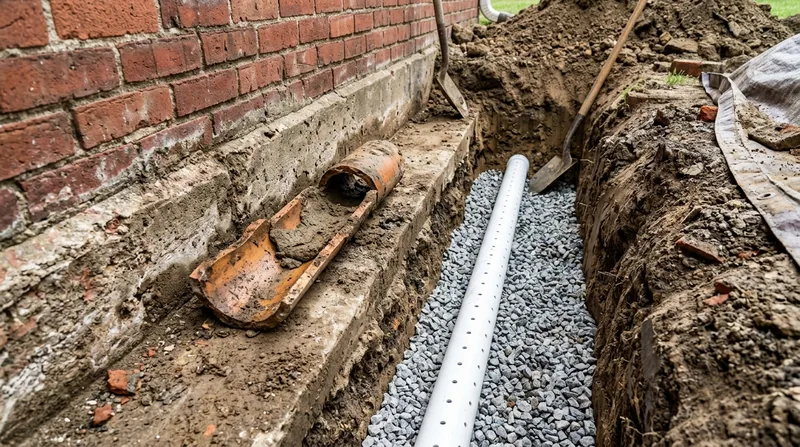




St. Joseph sits on wind-deposited loess bluffs above a bend of the Missouri River, and that geology decides how water moves under your house. Silt holds moisture, softens when saturated, and pushes against old brick and limestone foundations on Museum Hill, Hall Street, and Robidoux Hill. When the original clay footing drain under an 1890s Victorian or a 1920s bungalow in Patee Town has collapsed or filled with cottonwood roots, the water has nowhere to go but into the basement. Drain Tile Repair & Replacement in St. Joseph restores that buried drainage line with camera inspection, targeted excavation, and modern PVC so the footing drain actually moves water away from the wall again. If you are seeing a wet basement after every spring storm, the tile is the first thing we check. Start with a free basement inspection and we will tell you whether the tile is the problem or whether hydrostatic pressure is coming through the wall itself.
Why Drain Tile Repair & Replacement Matters on St. Joseph's Bluffs and River Bottoms
Most of the drain tile still buried under St. Joseph homes went in before 1950, and a good share of it is original clay tile laid in sections with open joints. Clay cracks under freeze-thaw cycles, silts up over decades, and roots from the oaks, elms, and river cottonwoods find every joint. Once the line is blocked, water stacks up against the footing and the wall starts to weep, efflorescence blooms on the brick, and the basement smells musty all summer.
- Original clay tile from the 1880s to 1950s collapses under root pressure and heavy spring rain.
- Blocked footing drains raise the water table against the foundation and drive hydrostatic pressure through mortar joints.
- Downspouts and steep bluff streets dump runoff against walls that were never designed for modern storm volumes.
- River-bottom clay along the Missouri, which flooded in 2011 and 2019, holds water long after the rain stops.
Repairing the tile is usually the difference between a basement that stays dry through June and one that takes on water every time the bluffs shed a storm.
Key info: On Cathedral Hill and Midtown, we routinely pull up cracked clay tile that has not moved water since the 1970s. A camera run through the line shows the break in minutes, and that changes the whole repair plan.
For questions about permits on drainage work, the City of St. Joseph's building department is the authority to check: City of St. Joseph, Missouri.
How We Repair and Replace Drain Tile Under St. Joseph Homes
We do not guess at a buried line. Every job starts with a camera pushed through the existing tile from the sump basin or a cleanout, and we mark the breaks, root intrusions, and settled sections on the surface. From there we choose between spot repair, re-routing, and full replacement, and we explain why one is right for your foundation. If the wall itself is also taking water, we may pair the tile work with an interior drain tile system so the basement has a path for water that reaches the floor.
- We camera-inspect the existing line and locate every failure point.
- We excavate only the sections that need it, keeping the trench tight to the footing.
- We remove collapsed clay tile, roots, and silt down to stable soil.
- We bed new perforated PVC in washed gravel with the correct fall toward the sump.
- We tie the line into the sump basin, test flow, and backfill in compacted lifts.
On the East Hills, where 1950s to 1970s ranches sit on block basements, we often find the tile intact but crushed where a driveway or patio was poured over it decades later. That is a targeted dig, not a full-perimeter job.
Key info: A homeowner in the South Side had water crossing the floor every March. The camera showed a root mass from a river cottonwood plugging the tile 14 feet from the basin. We cut out that section, replaced it in PVC, and the floor has stayed dry since.
Repair Approaches We Use in St. Joseph
Not every drain tile problem calls for the same fix. The right approach depends on how much of the line has failed, how deep it sits, and whether roots or settlement caused the break. Here is how we match the method to the failure.
| Approach | Description | Best for |
|---|---|---|
| Spot repair | Excavate and replace one failed section of tile, usually a root break or crushed span. | Isolated breaks in an otherwise sound line. |
| Sectional replacement | Replace a longer run of collapsed clay with perforated PVC bedded in gravel. | Multiple failures along one wall. |
| Full perimeter replacement | New PVC footing drain around the entire foundation, tied to the sump. | Original clay tile that has failed throughout. |
| Interior perimeter drain | New drain under the basement floor at the wall footing, leading to the sump basin. | Walls that weep and floors that take water, where exterior digging is impractical. |
| Sump tie-in and discharge | Connect repaired tile to the basin, check valve, and discharge line. | Any repaired line that needs a reliable exit point. |
Whichever method fits, the goal is the same: get water into the tile and out to a discharge point before it reaches the floor.
Drain Tile Repair & Replacement Cost in St. Joseph: What to Expect
Drain tile work starts at From $750 for a targeted repair, and most St. Joseph homeowners land between that figure and a few thousand dollars depending on how much of the line has to come out. The biggest cost driver is access: a line under a finished patio or a mature oak costs more to reach than one along an open side yard. Depth of the footing, length of the run, and whether the sump and discharge need upgrading also move the number.
- Spot repairs on one failed section stay near the low end of the range.
- Sectional or perimeter replacement costs more because of excavation, gravel, and PVC.
- Root removal and soil correction add labor when trees sit close to the line.
- Sump basin, check valve, and discharge work add to the total if they are part of the fix.
Get two or three estimates and ask each contractor whether they camera-inspected the line before quoting. A price without an inspection is a guess. Our full pricing overview lays out how the ranges break down.
Choosing a Drain Tile Repair Contractor Near Me in St. Joseph
Drain tile is buried work, so the contractor matters as much as the method. Ask for proof of liability insurance and workers' compensation before anyone digs, and confirm the crew is licensed for the scope. Call references from jobs done at least a year ago, since a drain that works in July may fail the next March. Ask who pulls the permit if the work alters drainage or the sump discharge connection, because thresholds vary and the local building department has the final word.
We are a Basement Health Association (BHA) member, we carry insurance, and we provide a certificate on request. To set up an inspection or ask about a line you suspect has failed, reach us through the contact page or call (816) 339-4515.
Drain Tile Repair & Replacement in St. Joseph: Pricing Guide
| Service | Price | Details |
|---|---|---|
| Targeted drain tile spot repair | Starting at $750 | Camera inspection, excavation of one failed section, PVC replacement, and backfill included. |
| Sectional drain tile replacement | Starting at $1,850 | Longer run of collapsed clay replaced in perforated PVC with washed gravel bedding. |
| Full perimeter footing drain replacement | On estimate | Requires on-site look at footing depth, access, tree proximity, and sump tie-in. |
| Sump basin and discharge tie-in | Starting at $650 | Connection of repaired tile to basin, check valve, and discharge line when added to a repair. |
| Travel | Included | In St. Joseph and surrounding Buchanan County areas, no separate call-out or mileage fee. |
| Estimate | Free | Response within 24 hours at (816) 339-4515, no obligation to book the work. |
Indicative pricing, the exact cost depends on square footage, finish, and site access. Free personalized estimate within 24h at (816) 339-4515.


